The South and Basilicata: the figures on female entrepreneurship
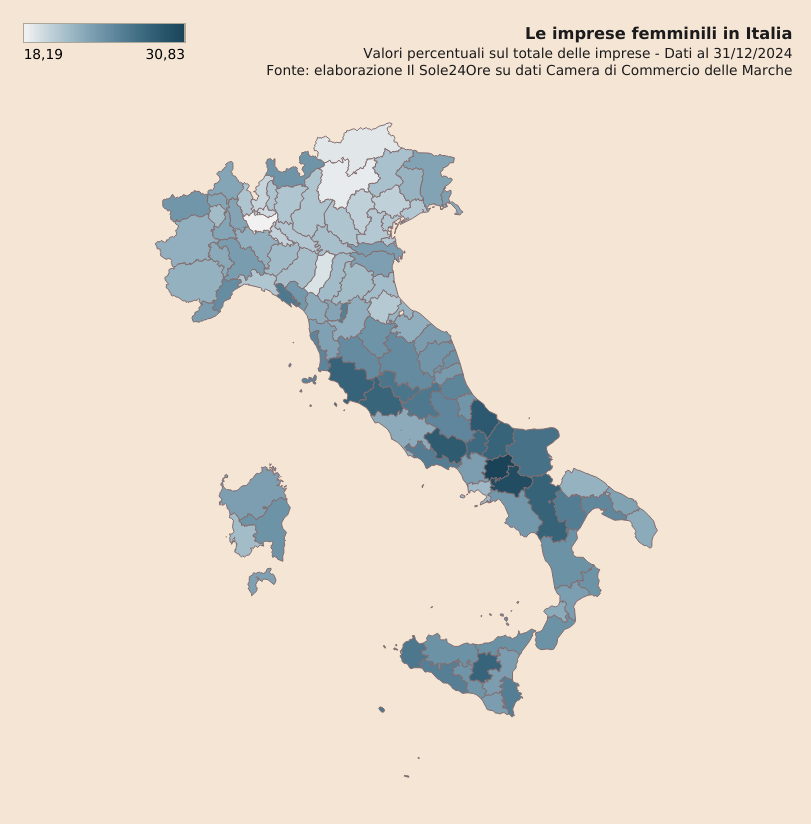
Female entrepreneurship represents a structural component of the Italian productive system, with more than 1.3 million companies led by women, accounting for 22.2% of the national total. However, the territorial distribution highlights a strong geographical divide: the phenomenon is significantly more widespread in the Mezzogiorno, where female participation in entrepreneurial activity often also fulfils a function of responding to lower salaried employment.
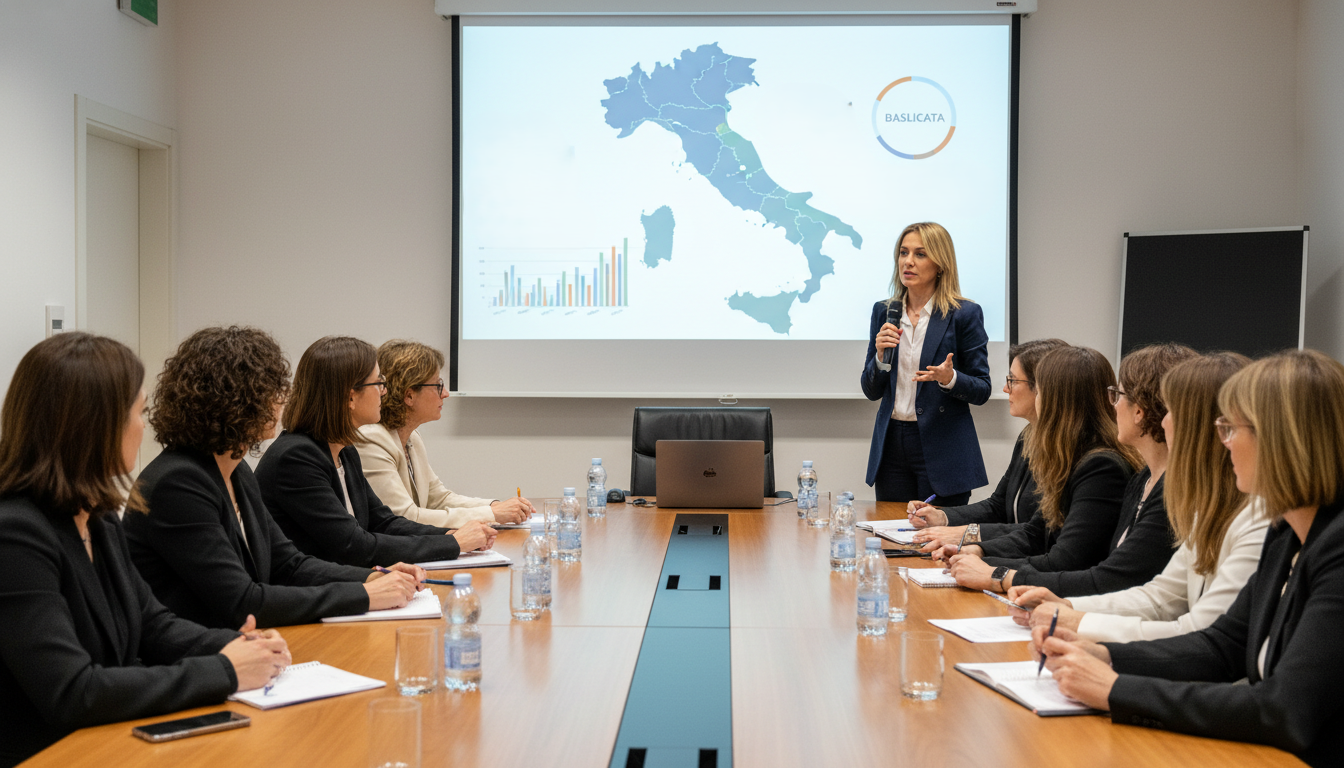
In this context, Basilicata stands out as one of the territories with the highest incidence of female-led enterprises in Italy. According to the most recent data (2024), companies led by women represent 26.5% of the regional total, a value significantly higher than both the national average (22.2%) and the Southern average (approximately 23.7%). This figure places the region at the top of the national ranking, just behind Molise.
From a structural point of view, a few distinctive characteristics emerge. Female enterprises in Basilicata are mainly micro-enterprises and sole proprietorships (approximately 74% of the total), with a strong concentration in traditional sectors, notably agriculture, commerce and services. However, signs of transformation are observed, with growth, albeit limited, also in more innovative fields such as professional and technical-scientific activities.
Another notable element concerns employment dynamics: in the Mezzogiorno, female enterprises show a greater propensity to hire compared to the national average (27% versus 22.5%), highlighting a potentially counter-cyclical and inclusive role in the labour market.
Overall, the comparison between Basilicata, the South and Italy reveals a dual scenario: on one hand, a greater diffusion of female entrepreneurship in the Mezzogiorno and in Basilicata in particular; on the other, the persistence of structural difficulties, linked to the small size of enterprises and their concentration in low value-added sectors. This qualitative gap represents today one of the main challenges for the consolidation and growth of female entrepreneurship in the territory.
In this context, Basilicata stands out as one of the territories with the highest incidence of female-led enterprises in Italy. According to the most recent data (2024), companies led by women represent 26.5% of the regional total, a value significantly higher than both the national average (22.2%) and the Southern average (approximately 23.7%). This figure places the region at the top of the national ranking, just behind Molise.
From a structural point of view, a few distinctive characteristics emerge. Female enterprises in Basilicata are mainly micro-enterprises and sole proprietorships (approximately 74% of the total), with a strong concentration in traditional sectors, notably agriculture, commerce and services. However, signs of transformation are observed, with growth, albeit limited, also in more innovative fields such as professional and technical-scientific activities.
Another notable element concerns employment dynamics: in the Mezzogiorno, female enterprises show a greater propensity to hire compared to the national average (27% versus 22.5%), highlighting a potentially counter-cyclical and inclusive role in the labour market.
Overall, the comparison between Basilicata, the South and Italy reveals a dual scenario: on one hand, a greater diffusion of female entrepreneurship in the Mezzogiorno and in Basilicata in particular; on the other, the persistence of structural difficulties, linked to the small size of enterprises and their concentration in low value-added sectors. This qualitative gap represents today one of the main challenges for the consolidation and growth of female entrepreneurship in the territory.
Returning to a rural village to start a business: advantages and disadvantages
Choosing to start a business in a small village like Pescopagano means embarking on a path that combines concrete opportunities with structural challenges. It is not merely an economic choice, but also a cultural and personal one, which requires an awareness of the context and an ability to adapt.
I Vantaggi: spazio, identità e incentivi per chi torna
Fare impresa in un borgo rurale consente di ridurre significativamente i costi: affitti più bassi, minori spese di gestione e maggiore accesso a spazi produttivi. Questo rende più sostenibile l’avvio di attività artigianali e creative, come la produzione di prodotti fatti a mano.
A ciò si aggiungono incentivi pubblici come Resto al Sud, che supportano nuove imprese nel Mezzogiorno con finanziamenti agevolati.
Un elemento sempre più rilevante è il valore del territorio come identità di brand. L’artigianato locale, lo storytelling e l’autenticità diventano leve fondamentali, soprattutto per chi lavora nel design indipendente e nella produzione sostenibile.
A ciò si aggiungono incentivi pubblici come Resto al Sud, che supportano nuove imprese nel Mezzogiorno con finanziamenti agevolati.
Un elemento sempre più rilevante è il valore del territorio come identità di brand. L’artigianato locale, lo storytelling e l’autenticità diventano leve fondamentali, soprattutto per chi lavora nel design indipendente e nella produzione sostenibile.
I limiti: poca clientela, distanze e necessità di vendere online
Il principale limite è la ridotta dimensione del mercato locale. In un piccolo borgo, la clientela non è sufficiente a sostenere molte attività, rendendo necessario rivolgersi a mercati esterni.
A questo si aggiungono distanze, logistica e digital divide, che complicano distribuzione, approvvigionamento e crescita.
Per questo motivo, oggi fare impresa nei borghi richiede quasi sempre una strategia digitale: vendere online prodotti come occhiali artigianali, design indipendente e manufatti locali diventa una condizione necessaria, non opzionale.
A questo si aggiungono distanze, logistica e digital divide, che complicano distribuzione, approvvigionamento e crescita.
Per questo motivo, oggi fare impresa nei borghi richiede quasi sempre una strategia digitale: vendere online prodotti come occhiali artigianali, design indipendente e manufatti locali diventa una condizione necessaria, non opzionale.
Entrepreneurship between roots and strategy: the ALAMASTR case
In the context of female entrepreneurship in Basilicata, the ALAMASTR experience represents a concrete example of how returning to a village like Pescopagano can transform into a journey as meaningful as it is complex. The choice to return and invest in a craft project tied to the territory stems from a precise vision: to unite identity, sustainability, and bespoke production. However, the operational reality has forced a direct confrontation with the structural limitations already highlighted.
Between return and reality: a year of engagement with the territory
The return to Pescopagano represented a moment of reconnection with one's own roots and with a more authentic and conscious business idea. Working in a rural context made it possible to develop the project with greater creative freedom and lower costs.
At the same time, however, the main difficulty became clear: the lack of a sufficient customer base to sustain the business in the short term. In a restricted local market, opening a physical shop from the outset would have entailed excessive risk, making it obvious that the strategy needed to be rethought.
At the same time, however, the main difficulty became clear: the lack of a sufficient customer base to sustain the business in the short term. In a restricted local market, opening a physical shop from the outset would have entailed excessive risk, making it obvious that the strategy needed to be rethought.
Beyond the village: building a hybrid and digital market
To make the project sustainable, it was necessary to go beyond local boundaries and build a broader model. In this sense, the connection with Naples represents a fundamental resource.
Naples offers a larger user base, a greater sensitivity towards artisanal products, and commercial opportunities that a small village cannot guarantee. The idea is not to abandon the territory of origin, but to complement local roots with a presence in a more dynamic urban market, creating a balance between identity and economic sustainability.
Alongside the physical dimension, the need to develop an online presence asserts itself strongly. For a brand like ALAMASTR, the digital is not just an additional channel, but a strategic lever to overcome geographical limitations.
A website and targeted communication make it possible to reach a wider audience, enhancing the uniqueness of the product and its story. In this model, Pescopagano becomes the place of production and identity, while the market extends well beyond local boundaries, to include national and international customers.
Naples offers a larger user base, a greater sensitivity towards artisanal products, and commercial opportunities that a small village cannot guarantee. The idea is not to abandon the territory of origin, but to complement local roots with a presence in a more dynamic urban market, creating a balance between identity and economic sustainability.
Alongside the physical dimension, the need to develop an online presence asserts itself strongly. For a brand like ALAMASTR, the digital is not just an additional channel, but a strategic lever to overcome geographical limitations.
A website and targeted communication make it possible to reach a wider audience, enhancing the uniqueness of the product and its story. In this model, Pescopagano becomes the place of production and identity, while the market extends well beyond local boundaries, to include national and international customers.
From local to global: wooden glasses and online presence
Alongside physical presence, digital is a fundamental strategic lever.
Through the website, ALAMASTR can reach customers interested in:
artisanal wooden glasses
handmade glasses
sustainable and customized eyewear
In this model, Pescopagano remains the productive heart, while the market extends nationally and internationally.
Through the website, ALAMASTR can reach customers interested in:
artisanal wooden glasses
handmade glasses
sustainable and customized eyewear
In this model, Pescopagano remains the productive heart, while the market extends nationally and internationally.
Female entrepreneurship and innovation: the role of the Pesco Innovation Hub
Transforming southern villages into places that are truly conducive to female entrepreneurship requires much more than individual initiative alone. Experiences like that of Pescopagano show that talent, vision and courage are not enough if they are not accompanied by an ecosystem capable of supporting and growing ideas. This is where the role of realities like Pesco Innovation Hub comes in.
For a village to become fertile ground for female enterprise, what is needed above all are more targeted and continuous public policies: economic incentives, yes, but also investments in digital infrastructure, mobility and essential services. Without a stable connection and without facilitated access to training and advice, even the best ideas risk remaining isolated.
Alongside institutions, it is fundamental to build local and supra-local support networks. Entrepreneurship in small towns cannot be a solitary path: connections, exchanges of skills, and collaboration are needed. In this sense, innovation hubs can become true catalysts, capable of connecting those who stay, those who return, and those who would like to invest.
Pesco Innovation Hub fits precisely in this direction: a space, physical and cultural, in which to experiment, share and build new possibilities. Not just coworking or training, but an active community, capable of generating concrete opportunities through mentoring, cross-sector contamination and openness towards broader markets.
The challenge today is to move from individual experiences to a collective model. To make villages places where starting a business is not a courageous exception, but a sustainable choice. This means investing in people, but also creating structural conditions that allow businesses, especially those led by women, to grow without necessarily having to abandon the territory.
The invitation is therefore concrete: to network, participate, contribute. Whether it is a matter of launching a project, sharing skills or simply approaching a reality like Pesco Innovation Hub, change starts from a community that activates itself. Because innovating from the margins is not only possible, it is, increasingly, necessary.
For a village to become fertile ground for female enterprise, what is needed above all are more targeted and continuous public policies: economic incentives, yes, but also investments in digital infrastructure, mobility and essential services. Without a stable connection and without facilitated access to training and advice, even the best ideas risk remaining isolated.
Alongside institutions, it is fundamental to build local and supra-local support networks. Entrepreneurship in small towns cannot be a solitary path: connections, exchanges of skills, and collaboration are needed. In this sense, innovation hubs can become true catalysts, capable of connecting those who stay, those who return, and those who would like to invest.
Pesco Innovation Hub fits precisely in this direction: a space, physical and cultural, in which to experiment, share and build new possibilities. Not just coworking or training, but an active community, capable of generating concrete opportunities through mentoring, cross-sector contamination and openness towards broader markets.
The challenge today is to move from individual experiences to a collective model. To make villages places where starting a business is not a courageous exception, but a sustainable choice. This means investing in people, but also creating structural conditions that allow businesses, especially those led by women, to grow without necessarily having to abandon the territory.
The invitation is therefore concrete: to network, participate, contribute. Whether it is a matter of launching a project, sharing skills or simply approaching a reality like Pesco Innovation Hub, change starts from a community that activates itself. Because innovating from the margins is not only possible, it is, increasingly, necessary.